





+18 - Check if the casino you want to register with is eligible in your country.
Stake provably fair is the system that lets a player recompute the result of a Stake Originals bet from a server seed, a client seed and a nonce, and confirm that Stake did not change its own input once the bet was placed.
While you play, Stake shows only a hash of its server seed and reveals the seed itself when you rotate the pair; slots and live tables supplied by outside providers are not part of the system.
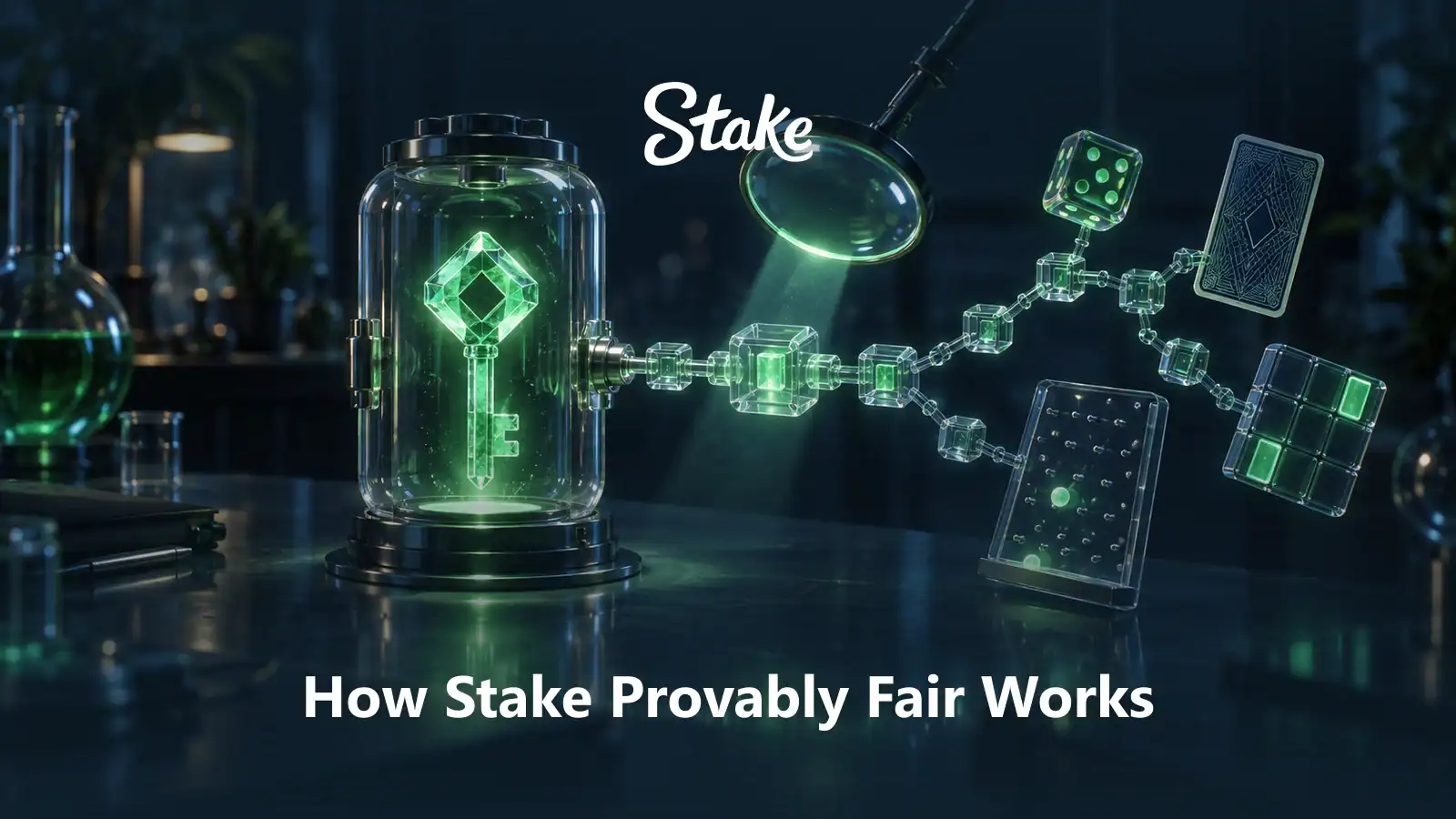
At Stake, provably fair describes a commitment made before each bet rather than a promise about winning. Stake fixes its own input, publishes a fingerprint of it and lets the player add an input of their own. Once the round is over, anyone holding those values can rerun the maths and check that the displayed game result is the one they produce. Stake’s overview page sums it up as a fair result built from the operator’s hashed input plus the player’s input.
The claim is narrow but useful: a verified bet shows that the outcome was not swapped after the stake went down. It says nothing about odds, which stay set by each game’s payout table. Many crypto casinos rely on the same commitment idea: Stake and BC.Game both publish their verification methods, and provably fair slots and table games elsewhere follow the same three-input logic. Stake’s version stands out for a fourth input called the cursor, a published list of covered games and a separate model for Crash and Slide.
For every verifiable bet, the Stake provably fair system feeds its server seed, your client seed, the nonce and the cursor into HMAC_SHA256, a keyed version of the SHA-256 hash function in which the server seed acts as the key. The output is 32 bytes. Stake reads them four at a time and turns each group into a decimal between 0 and 1, which gives far more precision than single bytes would.
Each decimal is then multiplied by the number of outcomes still possible in the game. A Dice roll draws from 10,001 values between 00.00 and 100.00, a Roulette spin from the 37 pockets of a European wheel, and a Plinko ball takes one left or right decision per row. Games whose outcomes cannot repeat, such as Mines, Keno and Video Poker, use a Fisher-Yates shuffle, so every tile or card drawn shrinks the pool for the next one.
Every step is deterministic: the same four inputs always return the same game result. That property is what turns a bet into something you can check after the event instead of taking on trust.
Each of the three named inputs has a distinct job, and the fourth only comes into play when a game needs many events from a single bet.
| Term | Plain-English meaning | Why it matters |
| Server seed | A random 64-character hex string generated by Stake, shown to you only as a hash until you rotate it | Locks Stake’s input before play, so it cannot be changed after a result |
| Client seed | A value that belongs to you; your browser creates one at registration and you can replace it at any time | Stops the server seed alone from deciding outcomes |
| Nonce | A counter that rises by one with each bet placed on the same seed pair | Gives every bet a new result without generating new seeds |
| Cursor | A round counter used when one 32-byte hash is not enough | Covers games that need more than eight events, such as Blackjack or Hilo |
Stake recommends choosing your own client seed through the fairness modal rather than keeping the one your browser generated, so that your influence is part of every seed nonce sequence that follows. Changing it starts a fresh chain of outcomes.
The cursor explains why some games consume more data than others. Mines uses three increments per game, Plinko and Keno two, Video Poker seven, while Blackjack and Hilo take as many as the hand requires. Dice, Limbo, Wheel and Roulette never move past the default value of zero.
Stake documents the system in its own Provably Fair section, split into an overview, the implementation, conversions from bytes to floats, game events and a calculation tool. The implementation page publishes the byte generator as code, and the game events page gives the formula each Original uses to turn a float into a card, a tile or a multiplier.
The same section names the Crypto Gambling Foundation, which lists Stake as a verified operator, and states that every Stake Original can also be checked on third-party sites that have open-sourced their method, with provablyfair.me given as an example. The official material is thinner on limits: the warning that not every game on the site is provably fair comes from Stake’s blog explanation, not from the Provably Fair section itself.
The official route to check a bet runs in six steps:
An independent verifier runs the same published function away from Stake. You paste the revealed server seed, your client seed and the nonce, pick the game, and the tool rebuilds the outcome; if it matches your bet history, the bet passes provably fair verification. A Stake seed checker usually also hashes the revealed server seed with SHA-256, and that is the one test that needs no trust in anybody’s code, because any standard hashing tool returns the same fingerprint.
| Tool or page | What it does | What it helps the player check | Notes |
| Stake calculator | Recomputes a bet from the game, both seeds and the nonce | Any game on its list, from Baccarat to Zoo | Official, on stake.com |
| Engine fair page | Replays results over a range of nonces and offers a public API | Engine slots and burst games | Official, for Engine titles |
| provablyfair.me | Verifier for a list of Stake Originals | Dice, Plinko, Mines, Crash and other Originals | Named on Stake’s overview page |
| StakeCruncher | Originals verifier and nonce analyser | Single bets, long nonce ranges and Crash points | States that calculations run in the browser |
| StakeSim | Seed checker with a SHA-256 hasher | Crash, Dice, Limbo, Plinko and Mines | States that no seed is sent to its servers |
A Stake verifier built by a third party is only as reliable as its code, and several of these tools sit on sites that also promote casino offers. Coverage varies too: one supports five games, another covers most Originals. Getting the same answer from Stake’s calculator and from an outside tool is a stronger signal than either result on its own.
The Stake calculator lists more than 30 games, from Baccarat, Bars and Crash to Tarot, Video Poker, Wheel and Zoo, including the in-house slots Scarab Spin, Tome of Life and Blue Samurai. All of them belong to the Stake Originals catalogue, and Stake states that every Original can be verified. Card games differ in one detail: Blackjack, Hilo and Baccarat draw from an unlimited number of decks, so every card keeps a one in 52 chance, whereas Video Poker deals from a single shuffled deck.
These three games do not use your personal seed pair. Stake says they run on a salt hash model, in which rounds come from a hash chain committed in advance, and for Crash and Slide it points to the public BitcoinTalk seeding thread that set the chain up. A Crash point is therefore checked by walking that chain, not by entering your own client seed, and independent tools such as StakeCruncher verify it the same way.
Stake’s blog lists every game built on Stake Engine as provably fair, the Only on Stake range included, and the Engine fair page limits that to stateless slots and burst games. The method differs from the Originals: every possible result and its selection probability is generated and published in advance, and your seed combined with the server seed picks one of them. Once the server seed is revealed, the Engine page can replay a whole range of nonces, return the payout for each one or search for the rounds that hit the maximum win.
Slots from outside providers, live dealer tables and RNG table games are not covered. Stake’s own explanation says titles from other software providers use their own technology and RNG, and that a slot does not become provably fair just because it is listed on Stake. For those games, fairness rests on the provider’s testing and certification, which a player cannot recompute bet by bet.
Provably fair answers one question well and leaves several others open:
Searches on that question lead mostly to forum threads and videos. Some critics go further: a Medium post argues that provably fair shows how a result was produced rather than whether it was chosen against the player, and forum users point out that the casino can compute upcoming results once both seeds are set. Stake’s published function answers part of this. Its four inputs are the two seeds, the nonce and the cursor, and the bet amount is not among them, so a bet that verifies was not shaped by how much you staked. Knowing a result in advance is also different from being able to change it, since any change would break the hash you already hold.
What verification cannot settle is whether a provider slot behaves as its studio says, or whether a streamer’s results are typical; those depend on external testing, sample size and each game’s maths. Nor does it say anything about licensing or how accounts and withdrawals are protected, which form the other half of whether Stake is safe and legit. If losing runs start to drive your sessions, responsible gambling tools such as deposit limits and self-exclusion will do more for you than any hash check.
Both approaches produce unpredictable results; the difference lies in who can check them. With a standard RNG, you see the outcome and rely on the operator’s systems and their external testing. With provably fair, each bet leaves a trail of seeds, hash and nonce that you can rerun. Stake does not treat the two as rivals: it says its Originals combine certified random number generation with provable fairness, while its non-dealer table games rely on RNG alone.
In practice the rule is simple. On an Original or an Engine title, you can verify result data yourself with the seeds in your history; on everything else, you judge the provider and its certification instead.
No. Stake Originals and games built on Stake Engine, Only on Stake titles included, can be verified. Slots from outside providers, live dealer games and RNG table games use their own systems, and Stake itself warns against assuming that every game in its lobby is provably fair.
Rotate your seed pair so that Stake reveals the server seed, then open the bet from your history and use its fairness option, or enter the game, both seeds and the nonce in Stake’s calculator. Finally, hash the revealed server seed: the output should equal the hash shown before you played.
Yes. Stake says its Originals can be checked on third-party sites that publish their method, and tools such as provablyfair.me, StakeCruncher and StakeSim rebuild results from your seeds and nonce. Coverage differs from one tool to the next, so confirm that yours supports the game before relying on its answer.
It means the result was produced from inputs fixed before the bet and was not altered afterwards. It does not lower the house edge, reduce variance or make a game better value. Those depend on the payout table of each game, which verification leaves untouched.
The server seed is Stake’s secret input, shown as a hash until you rotate it. The client seed is your own input, which you can change whenever you like. The nonce counts your bets on one seed pair, so each bet gets a different result from the same two seeds.
An RNG game shows you the result and asks you to trust the operator and its testing. A provably fair game hands you the seeds and nonce needed to recompute that result. Stake uses both, with certified RNG inside its Originals and provable fairness layered on top.

Secod has streamed and tested games on Stake extensively, giving him direct insight into the platform’s bonuses, features and gameplay conditions. His experience ensures every Stake review reflects real usage rather than surface level analysis.

© 2018-2026 bonustiime.com






Casiibro is currently offline.
Learn more about them on their channel!
▶ Visit Casiibro's channelOr head to the Stream Hub.