







+18 - Check if the casino you want to register with is eligible in your country.
Stake.com attaches a statistics panel called Game Insights to every slot, showing each game's real return-to-player and betting volume instead of just the provider's theoretical figure. Read it well and it tells you how a slot is actually performing before you spin; read it wrong and it quietly feeds the gambler's fallacy. This guide covers what the panel shows, what it does not, and how to use it. Some players call it "live RTP", though as you'll see, the reality is more nuanced.

Game Insights is a statistics panel available on every slot on Stake.com that reports the game’s real RTP, amount wagered, and bet count across four time windows, letting players see how a slot has actually performed before they spin. You open it from the Game Insights toggle in the game info bar, just below the game window, then read the Game Statistics tab. Unlike theoretical RTP, the long-run mathematical figure published by the provider, Game Insights reflects what has genuinely happened on that slot on Stake during each window. The data is aggregated and refreshed periodically, not streamed live with every bet. It removes the need for third-party RTP trackers because the figures sit inside the platform, on the game itself, before you commit any funds.
Open any slot on Stake.com. In the bar just below the game window, next to the game title and the Save Game button, you’ll see a Game Insights toggle on the right, so expand it. The default view is the Game Statistics tab, with a Statistics sub-tab showing the period table. Two further sub-tabs, Big Wins and Lucky Wins, surface notable individual results. A separate Your Statistics tab shows your own play on that game, and Challenges and Description tabs sit alongside.
Each row in the Game Statistics table is a different time window, and reading them side by side is how you judge whether a slot’s current RTP is reliable or just short-term noise. Here is the real panel for Gates of Olympus 1000 (Pragmatic Play), captured on Stake:
| Period | RTP | Total Wagered | Total Bets |
|---|---|---|---|
| Last 24 hours | 93.15% | $9,551,856 | 2,615,954 |
| Last 7 days | 95.05% | $57,986,807 | 17,075,462 |
| Last 28 days | 96.37% | $257,842,510 | 72,800,599 |
| All time | 96.02% | $7,388,728,208 | 2,038,592,738 |
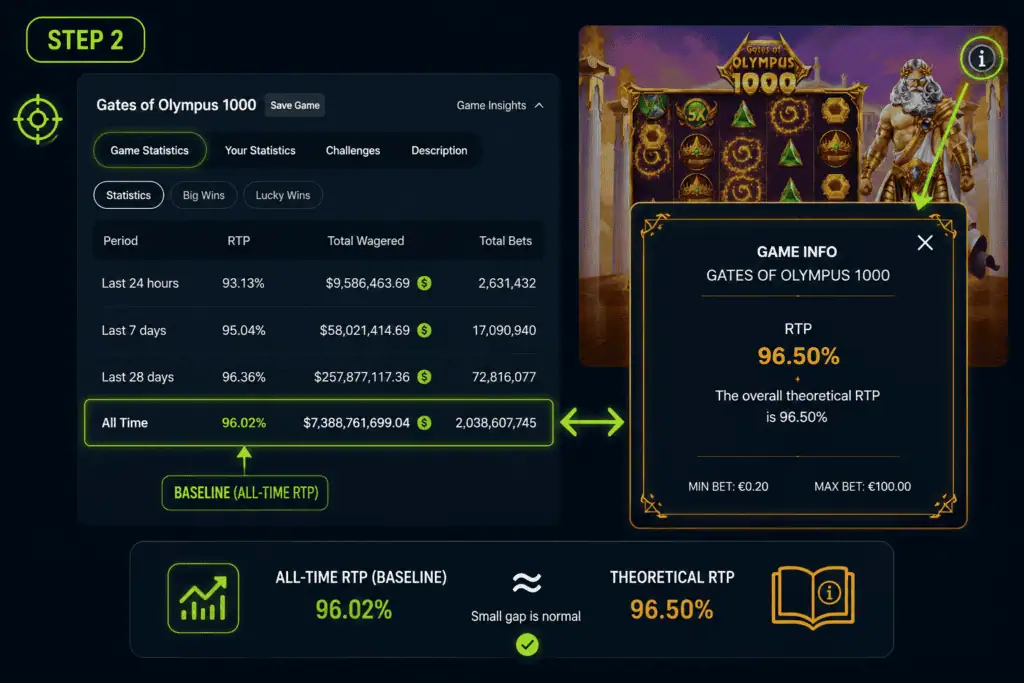
Read it like this. The all-time row is the most statistically mature figure: across more than 2 billion bets and $7.3 billion wagered, the RTP has settled at 96.02%, close to the game’s published theoretical RTP (around 96.5%, always verify in the game’s rules). The shorter windows swing around it. At 93.15% over the last 24 hours, on a comparatively tiny sample of 2.6 million bets, the slot is currently paying below its long-run average. The 28-day window, at 96.37%, sits slightly above all-time. None of this predicts the next spin, but it tells you precisely how the game is tracking right now versus its baseline.
Total Wagered is the cumulative money staked on that slot during the window; Total Bets is the count of rounds played. One is an amount, the other is a count, and confusing them is the fastest way to misread the panel. Both feed the RTP: RTP is the share of Total Wagered that came back to players over that window.
The two activity columns are not interchangeable. The same bet count can hide very different wagered totals depending on stake sizes: 1,000 spins at $1 is $1,000 wagered, while 1,000 spins at $100 is $100,000. If you want the money returned to players, multiply Total Wagered by RTP. For the all-time window above: $7.39B × 96.02% ≈ $7.09B paid back to players. The gap between wagered and paid back is the house edge at work.
A slot whose 24-hour or 7-day RTP sits well below its all-time figure is currently running cold; one sitting above is running hot, but neither state changes the odds of your next spin. This is the law of large numbers in plain sight. Over a small sample (a single day, a few million spins), random variance pushes RTP away from the theoretical baseline. Over billions of spins, it converges back. Gates of Olympus 1000 illustrates it perfectly: 93.15% over 24 hours, settling to 96.02% all time as the sample grows.
The practical read: short-window RTP is a snapshot of recent variance, not a signal of what’s coming. A slot at 93% over 24 hours is not “due” to bounce back to 96% on your spins, and one at 98% over 7 days is not “hot” for you personally. The value of the comparison is honesty: it shows you the spread between recent reality and long-run design, so you choose with open eyes instead of a marketing number.
Read the all-time RTP for the baseline, weigh the wagered volume for reliability, then compare the shorter windows to see how the slot is behaving right now, before matching it to your bankroll. Follow these four steps:
Step 1: Open the Game Insights toggle. It sits in the bar just below the game window, on the right, next to the game title. Expand it and stay on the Game Statistics tab to see the four-period table (24h, 7-day, 28-day, all-time).

Step 2: Read the all-time RTP as your baseline. This is the most statistically mature figure. Compare it to the published theoretical RTP in the game’s rules (the “i” or Rules button). A small gap is normal; the all-time figure shows how the game has tracked its design across its full history on Stake.
Step 3: Judge the volume relative to the slot itself. There is no universal “reliable” number. A popular title like Gates of Olympus 1000 carries billions in all-time wagering, while a niche slot may have a few thousand bets. An all-time figure in the hundreds of millions or billions is statistically mature. Then notice how small the 24-hour or 7-day sample is next to it: that gap is exactly why the short windows swing.
Step 4: Compare the periods and decide. A short window sitting well below the all-time RTP means the slot is running cold right now, not that it is “due” to correct. A tight cluster means it is tracking its design. Factor in the game’s volatility (check the rules, since Game Insights does not show it), then match the choice to your bankroll and limits. Our wager calculator helps you size a session before you start.
Open both games and read their all-time RTP and wagered volume first, then their period tables. Prioritise volume over a flashy short-window number: a slot at 96.5% all-time across billions wagered is a more reliable read than one at 99% over a few thousand bets. Volume first, RTP second.
Game Insights is a transparency tool, not a prediction tool. It shows what has already happened; it tells you nothing about the next spin, the next session, or when a jackpot will land. Every spin on a certified slot is independent: the RNG does not “remember” a cold 24-hour RTP and does not owe you a correction. If a slot has paid 93% over the last day, your next spin’s odds are still governed by the game’s theoretical RTP and its RNG, not by the recent figure.
This is the gambler’s fallacy, and the panel can quietly feed it if you let it. A low recent RTP is not a slot that’s “about to pop.” A high recent RTP is not a slot that’s “hot.” High wagered volume and high bet counts mean a game is popular, not due. Use Game Insights to understand reliability and current variance, never as a system to time wins.
Popular high-RTP titles like Gates of Olympus 1000, Sweet Bonanza, and Wanted Dead or a Wild accumulate huge wagered volumes on Stake, which makes their all-time Game Insights RTP a statistically mature reading worth checking against the published theoretical figure. Because these games are heavily played, their all-time windows contain hundreds of millions to billions of bets, exactly the sample size where RTP settles close to its design. Open the panel on each, note the all-time RTP and wagered volume, then see how the recent windows compare. You can start from the most popular slots on Stake and work down.
Published theoretical RTPs vary by provider and version, so always confirm the exact figure in each game’s rules before comparing it to the Game Insights number. As a rule of thumb, most mainstream Stake slots publish theoretical RTPs between roughly 94% and 97%, with a handful of titles above that.
Most casinos publish only a static theoretical RTP in a rules tab. Stake surfaces real, period-based performance data on every slot, a level of transparency very few competitors match. Traditional operators show you the provider’s theoretical figure and nothing about what players are actually experiencing on their platform. Stake exposes the real RTP, wagered volume, and bet counts across four windows, in-game, before you spin. It’s consistent with the provably-fair philosophy the platform is built on: publish the data, let players judge for themselves.
That transparency doesn’t change the house edge (it never can), but it does change the quality of the decision. Picking a slot with visibility into its real performance and trading volume is a more informed choice than picking one off a theme tile and a single marketing percentage. New players can check the current Stake bonuses before depositing.
No statistic removes the house edge or guarantees a win. Game Insights helps you choose more deliberately; it does not tilt the maths in your favour. Even a 97% RTP slot keeps 3% of everything wagered over the long run, and short-term variance can run far harsher than that. Treat your slot budget as money you can afford to lose, set a loss limit and a stop point before you start, and don’t let a recent RTP figure tempt you past them.
Stake provides deposit limits, loss limits, session-time limits, and self-exclusion in your account settings under Responsible Gambling. If gambling stops feeling like entertainment, use them, and reach out to a support organisation such as GamCare or Gamblers Anonymous.
Stake.com is operated by Medium Rare N.V. under a Curaçao licence (OGL/2024/1451/0918, Curaçao Gaming Authority). It is not regulated by traditional gambling authorities in most Western jurisdictions. Before playing, confirm that online gambling is legal where you live and that Stake.com is accessible and compliant in your jurisdiction.
Stake accepts cryptocurrency (Bitcoin, Ethereum, Litecoin, and others) and fiat via third-party processors. Crypto withdrawals are typically fast; network fees may apply and blockchain transactions are irreversible. Stake’s slots are supplied by certified third-party providers (Pragmatic Play, Hacksaw Gaming, Evolution, and others) and audited for fairness. Note that Game Insights RTP reflects activity on Stake specifically, so results on other casinos running the same games will differ.
Affiliate disclosure: BonusTiime may earn referral commissions when players sign up to Stake.com through our links. This does not influence our analysis. We test Stake’s features directly and report what we find.
No. Game Insights reports RTP across four fixed periods (last 24 hours, last 7 days, last 28 days, and all time), and the figures are aggregated and refreshed periodically. It is not a live, spin-by-spin ticker. The all-time figure is the most stable; the shorter windows move more because they cover smaller samples.
Total Wagered is the cumulative amount of money staked on that slot during the selected window, shown as a dollar figure. It sits beside the RTP and Total Bets columns. To estimate the money returned to players in that window, multiply Total Wagered by the RTP; the difference between the two is the house edge.
No. Total Bets is the number of rounds played on the slot in that window, not a sum of money. The money staked is shown separately in the Total Wagered column. For example, Gates of Olympus 1000 shows roughly 2.6 million bets over 24 hours and 2.04 billion all time.
Theoretical RTP is the long-run mathematical expectation set by the game provider over millions of spins, and it’s static. Game Insights RTP is the actual return players have experienced on that slot on Stake during a specific window, and it fluctuates. Theoretical RTP describes the game’s design; Game Insights describes its recent and lifetime reality on Stake.
No. A low recent RTP means the slot has paid below its average lately, that’s all. Each spin is independent under the RNG, so the game is not “due” to correct on your spins. Recent RTP reflects past variance, never future outcomes. Treating it as a signal to play is the gambler’s fallacy.
Most mainstream slots on Stake publish theoretical RTPs between roughly 94% and 97%, clustering around 96%. A small number of titles sit higher. Always check the exact theoretical RTP in each game’s rules, then compare it to the all-time figure in Game Insights to see how closely the game is tracking its design on Stake.
No. Game Insights shows aggregate activity (RTP, total wagered, and total bets) but never individual player identities or bet sizes. The Big Wins and Lucky Wins sub-tabs surface notable wins without exposing personal details.

Secod has streamed and tested games on Stake extensively, giving him direct insight into the platform’s bonuses, features and gameplay conditions. His experience ensures every Stake review reflects real usage rather than surface level analysis.

© 2018-2026 bonustiime.com








Casiibro is currently offline.
Learn more about them on their channel!
▶ Visit Casiibro's channelOr head to the Stream Hub.