






+18 - Check if the casino you want to register with is eligible in your country.
Stake Shield is an optional setting in the Stake sportsbook bet slip that keeps a multi bet alive when a chosen number of its legs lose, in exchange for lower odds and a payout fixed before the bet is placed.
It opens on multis of three or more pre-match legs, cannot include live selections, same game multis, racing, player props or outrights, and removes the option to cash out once the bet is placed.
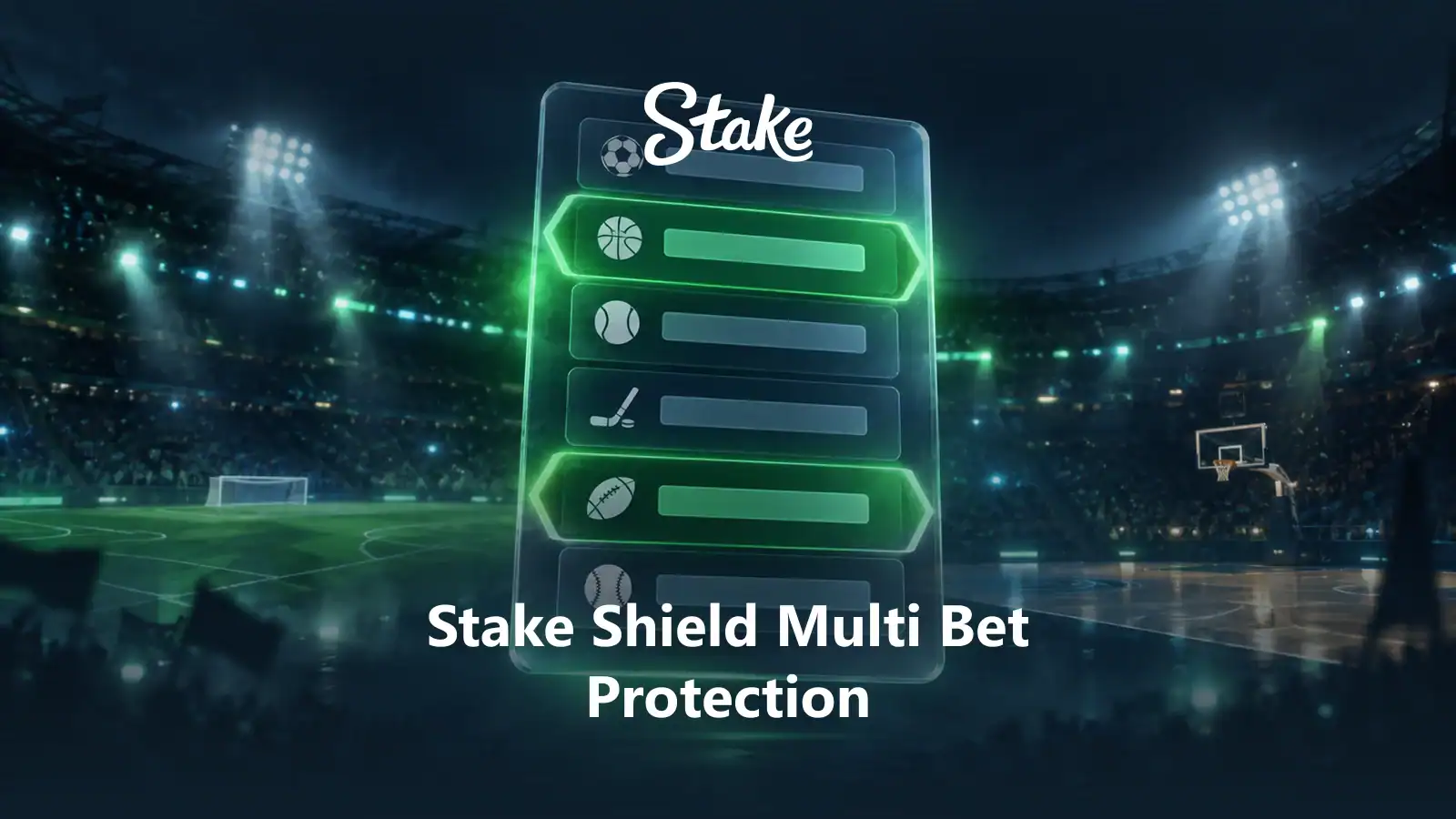
Stake Shield is an optional feature of the Stake sportsbook that lets a multi bet survive one or more losing selections. In an ordinary multi bet, every leg has to win: one wrong pick and the whole ticket is lost. With Stake Shield switched on, you decide in advance how many legs are allowed to lose, and the bet still pays if that condition is met. Stake’s help centre also calls the feature Flexi Bet, and both names circulate on social media and in betting forums.
The protection is not free. Stake reprices the bet before it is placed, so a shielded multi carries lower odds than the same selections played as a straight accumulator. What you get in exchange is a smaller but more reachable payout, fixed at the moment you confirm the slip.
Stake lists the feature on its promotions page with a fixed end date, although the same conditions are also written into the general rules of the sportsbook, which is where they will still apply if the promotion listing is renewed or removed. It sits inside the bet slip of Stake’s sports betting rather than in a separate menu, and it appears only when the slip holds enough selections to qualify. Nothing changes for a single bet, and nothing changes for a multi on which the switch is left off, since the feature is never applied by default.
How Stake Shield works comes down to one choice: the number of losing legs you want covered. Stake then calculates a fixed payout for that protection level and shows it on the bet slip. The payout does not depend on which particular legs win or lose; only the count matters. Each extra leg of protection lowers the payout again, so covering two losing legs always pays less than covering one.
Typical win conditions on smaller multis look like this:
This is what Stake Shield multi bet protection means in practice: the losing legs are absorbed by the chosen condition, not refunded one by one. If the number of losing selections goes beyond the condition, the whole bet loses exactly as a standard multi would. If every leg wins, the bet still pays the fixed amount chosen at placement, not the full accumulator price, which is the part of the trade-off players most often overlook.
Forum posts and social media describe shielded slips as “2 of 3” or “4 of 5” bets: the label gives the condition, and the odds on the slip show what it costs.
Stake Shield availability starts at three selections. With 3+ leg multis the option appears automatically on the bet slip; with one or two legs it is not offered at all. Stake’s guide says the feature works across the sportsbook, naming football, tennis, basketball, cricket, ice hockey, American football, MMA and esports titles such as CS2, Dota 2 and League of Legends.
The sportsbook rules narrow that list. A selection cannot be part of a Stake Shield bet if it is:
The two official texts do not fully agree. Stake’s guide lists horse racing among the sports where the feature can be used and describes same game multis in the same article, while the rules exclude racing and same game multis outright. When the two differ, the rules published in the sportsbook policy are the ones that settle a bet, so a slip built on pre-match match markets, such as NBA game lines or football results, is the safe way to see the option appear. Because a single ineligible leg makes the switch disappear, removing that leg is usually enough to bring it back.
How to use Stake Shield is set out in four steps in Stake’s help centre, and the whole process happens in the bet slip:
The steps are the same on a phone and on a computer, since the switch lives in the bet slip itself. Two details are worth checking before the final tap. First, the odds of the chosen protection level must be above 1.01, so a heavily shielded slip of short-priced favourites may leave some conditions unavailable. Second, a shielded bet is final: cash out is not offered on it, so there is no way to take an early return if the first legs go well. Anyone who likes to cash out halfway should keep that bet as a standard multi, and anyone setting a stake should size it for the reduced payout shown, not for the full accumulator price.
The payout of a shielded bet is a fixed payout based only on the number of legs protected. Stake’s own example uses a six-leg Champions League multi on Atlético Madrid, Newcastle United, Inter, Paris Saint-Germain, Juventus and Real Madrid, all to win:
| Protection chosen | Odds shown | Share of the unprotected price | What has to happen |
| None (standard multi) | 5.88 | 100% | All 6 teams win |
| 1 losing leg | 1.89 | About 32% | At least 5 of 6 win |
| 1 or 2 losing legs | 1.15 | About 20% | At least 4 of 6 win |
This Stake Shield payout example shows how steep the reduced odds can be. Protecting one leg cuts the price to about a third of the straight multi, and protecting two leaves a return of 15% profit on the amount staked. On the US$100 stake used in Stake’s example, those prices return US$588.47, US$189.12 and US$115.29. The figures come from a single slip; the prices on another slip depend on its legs.
Two more rules shape the payout. The odds and payout stay fixed even when every selection wins, unless a leg is voided. And if a market in the bet is settled under dead heat rules, or can end in a split win, the payout is adjusted in line with that settlement.
A void selection is not a losing leg. A leg is voided when its market cannot be settled normally: under Stake’s football rules, for instance, a match interrupted and not resumed within 48 hours has its undecided bets voided. In a Stake Shield bet, a voided leg is removed and the odds are recalculated without it.
The timing of the void decides what happens next:
The practical consequence is that a void can lower the payout of a shielded multi, because the odds of the removed leg drop out of the price, but a void is never counted as one of the losing legs the shield absorbs. Same game multis, where a single void cancels the whole bet under Stake’s rules, are one reason those bets are kept out of the feature.
Stake Shield vs standard multi is a trade between full upside and a conditional payout. A standard multi, also called an accumulator or parlay, multiplies the odds of every leg and pays only if all of them win. A shielded multi gives up most of that multiplied price in exchange for room to miss.
| Feature | Standard multi | Stake Shield |
| Legs that must win | All of them | The number set by your condition |
| Payout if all legs win | Full combined odds | The reduced fixed payout |
| Live selections | Part of Stake’s live betting | Not allowed |
| Same game multis | A bet type of their own | Not allowed |
| Cash out | On selected pre-match and live events | Not available |
| Void leg | Settled under the market rules | Recalculated under the Stake Shield timing rules |
A shielded multi is also different from a system bet. A system bet splits the stake across several smaller accumulators and pays each winning combination separately, so its return varies with which legs win. Stake Shield keeps a single bet with a single fixed payout, which is simpler to read but less flexible in how it pays.
The trade-off has critics. A player on Stake’s community forum pointed out that the shield lowers the payout even when every pick wins, argued that it probably lowers long-term expected value compared with a regular multi or with simply dropping the uncertain legs, and asked Stake to publish side-by-side value comparisons. The feature reduces the swings of a multi; it does not make the bet better value.
Most confusion around the feature comes from names and from rules that sit in two places.
The limit worth remembering is the one on risk. The shield changes how often a multi pays, not how much a bettor can afford to lose, and a slip with more legs still loses more often than a short one. Before placing a shielded football accumulator or any other multi, set the straight price beside each protection level on the slip: the gap between them is what the shield costs.
Stake Shield is an optional feature of the Stake sportsbook, also called Flexi Bet, that lets a multi of three or more legs still pay when a chosen number of legs lose. In exchange, the odds are reduced and the payout is fixed before the bet is placed.
You add at least three eligible selections, switch the shield on in the bet slip and choose how many legs must win. Stake shows the adjusted odds and the fixed payout for that condition, and the bet pays if at least that many legs win.
Yes. Each extra leg of protection lowers the odds, and the reduced payout applies even if every selection wins. In Stake’s six-leg example, a 5.88 multi drops to 1.89 with one leg protected and to 1.15 with two.
The switch appears once a multi holds three eligible legs. Live selections, same game multis, racing, player props and outrights cannot be included, so one of those in the slip is enough for the option to vanish.
Yes, it changes the price but not the protection. The voided leg is removed and the odds are recalculated, once the bet has won if the void came first. If the recalculated odds fall below 1.01, the whole bet is voided.
In betting, the stake is the amount you place on a bet, so a stake of 10 means risking 10 units of your currency, such as €10. It has nothing to do with the Stake brand or with Stake Shield, even though the words overlap in searches.

Secod has streamed and tested games on Stake extensively, giving him direct insight into the platform’s bonuses, features and gameplay conditions. His experience ensures every Stake review reflects real usage rather than surface level analysis.

© 2018-2026 bonustiime.com







Casiibro is currently offline.
Learn more about them on their channel!
▶ Visit Casiibro's channelOr head to the Stream Hub.